From QA Engineer to Agent Operator
A 5-level on-ramp to agentic AI for people who already know the one thing the model doesn't — how to tell "correct" from "plausible."
A field guide for experienced QA engineers sitting down at the wheel of an AI agent for the first time. No “ask the model to write your test cases” — everyone has already taught you that.
“Is this going to replace me?”
Almost every QA engineer I’ve talked to over the last six months has asked me that question. Quietly, half under their breath — as if asking were something to be ashamed of.
My answer usually surprises them: out of the entire engineering team, you are one of the best-positioned people to operate AI agents. Not despite being “just” a QA engineer — but precisely because you are one.
Let me explain why. Then I’ll hand you a five-level ladder: how to go from “I paste questions into a chat” to “I have a quality feedback loop running on autopilot” in roughly a month. This isn’t theory from a slide deck — I climbed every level myself, on Claude Code and Cowork, and collected my bruises on each one. I’ll describe those too, so you collect fewer.
Why a QA engineer is the best agent operator
A QA engineer’s whole career is spent building one thing the English literature calls the oracle: the internal judgment of whether a system is behaving correctly. You spent years learning to look at a screen and say “that’s a bug, and that’s by design.”
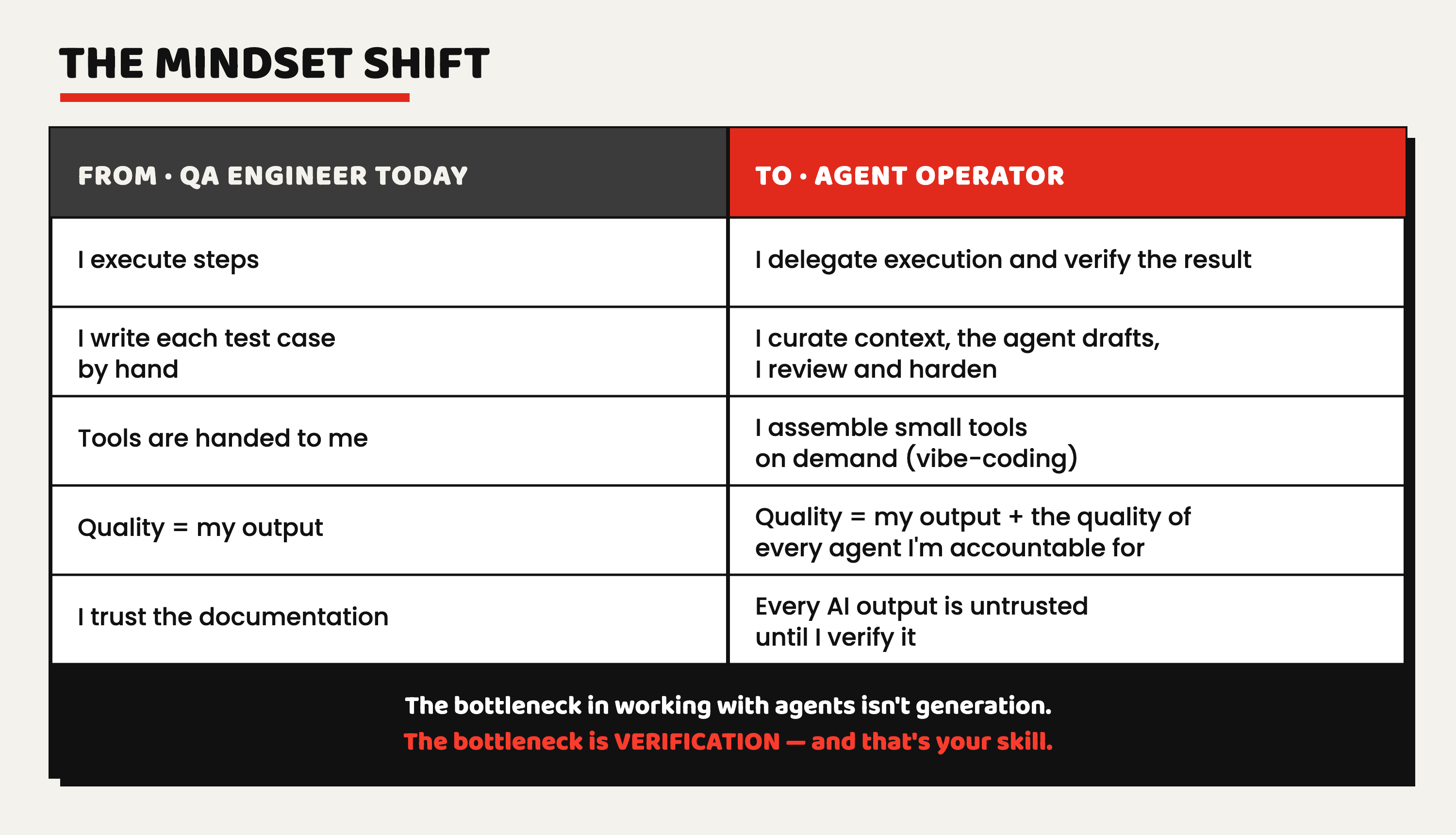
Agentic AI is fast, tireless, and confidently wrong. It’ll generate ten test cases in fifteen seconds, and three of them will be quietly broken. The bottleneck in working with agents isn’t generation — it’s verification. And verification is exactly the skill you’ve been sharpening all these years.
You already own the one skill the agent is missing: the ability to decide whether an output is correct.
A developer opening an agent for the first time gets a machine that writes code faster than they do, and freezes, because they’re not used to doubting every line. You are. You’ve spent your whole career treating every build as a suspect. Now the suspect is just the agent itself.
Here’s the mindset shift this article is about:
And two rules that run through all five levels and aren’t up for debate:
- Treat LLM output like untrusted input from a black box. You already know how to do this — you do it to every build under test. Point the same suspicion at the agent.
- Never delegate a task whose result you can’t verify. If you can’t state the oracle, you’re not ready to delegate that step yet.
The Map: 5 levels + 1 cross-cutting track
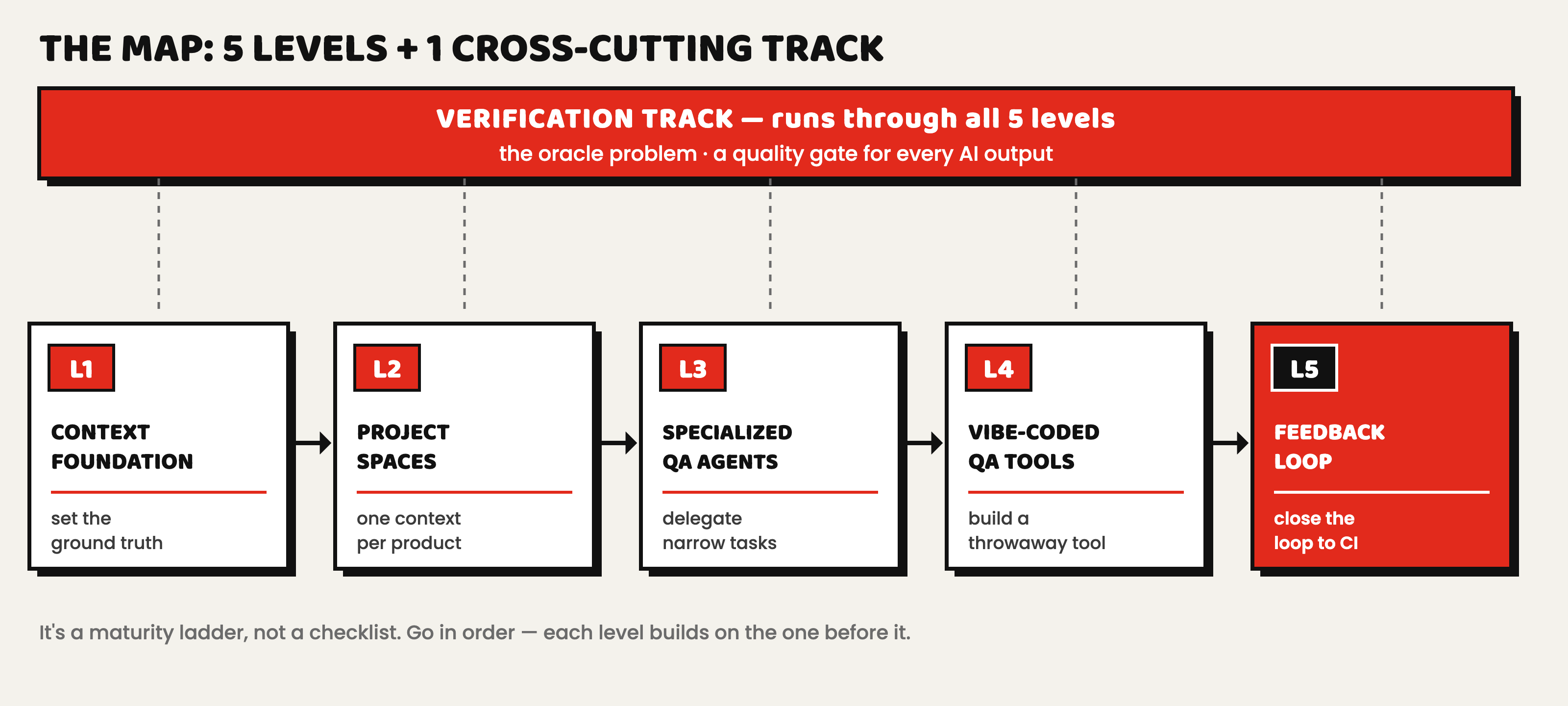
The five levels are a maturity ladder, not a checklist. Go in order — each one builds on the last. The Verification Track isn’t a sixth step; it’s the discipline you apply inside every level.
Level 1 — Context Foundation
Replace “I upload files one at a time” with a stable ground truth the agent reasons from.
An agent with no context invents plausible nonsense. An agent with your context tests your system. For a QA engineer, “context” is your engineering ground truth: the documents that define what “correct” and “done” actually mean on your product.
What to assemble — the QA context pack:
CLAUDE.md/ project context file — stack, environments, how to run things, what not to touch, where the risky areas are.- Definition of Done and test standards — what a good bug report contains, your severity/priority rules, your test-case format.
- Domain glossary — product terms, user roles, business rules. This is where your tacit knowledge gets written down so the agent can use it.
- Known-risk register — flaky areas, historically buggy modules, integration seams. Your scar tissue, written down.
Claude Code / Cowork mechanic: use a project (Cowork) or a repo-level CLAUDE.md (Claude Code) so the context loads automatically every session. Don’t paste it in each time.
A trick that worked for me: let the agent interview you. Tell it: “Interview me for 20 minutes, one question at a time, to document the test strategy and risk areas of this product.” Tacit knowledge comes out far faster through a back-and-forth than from a blank page.
Do today (30 min): create a
CLAUDE.mdfor one product you test. Put in: how to run it, the 3 riskiest areas, your bug-report format, and 10 domain terms. Then ask the agent to describe your product back to you and find the holes in your own document.
Verification @ L1: read what the agent wrote about your product. Every factual error is a hole in your context, not just an AI slip. Fix the context, not the chat.
Exit criterion: a fresh chat, opened cold, describes your product and quality bar correctly — without you re-explaining anything.
Level 2 — Project Spaces
One isolated context per product/service instead of a single chaotic chat history.
A project space is a dedicated, isolated working environment for one product: a Project in Cowork, or a project folder with its own CLAUDE.md in Claude Code. Inside it lives the context for that product only — and nothing else’s.
Stop running everything in one sprawling conversation. Set up a space like this per product, service, or test domain (“Payments API testing,” “Mobile regression,” “Onboarding flow”). Each space carries its own Level 1 context.
Why this matters for a QA engineer specifically:
- Onboarding flips. Instead of “read these 14 Confluence pages and watch the recording,” a new colleague gets access to the space. The agent already knows where testing left off, what’s covered, what’s flaky, and what’s next. You become the person who builds that onboarding asset.
- Context stays clean. Payments knowledge doesn’t bleed into mobile testing. Fewer hallucinations, sharper answers.
Do today (45 min): stand up one space for the product you test most. Drop in your L1 pack plus your current test charter and open risks. Then ask: “If a new QA joined today, what should they test first and what should they watch out for?” Judge whether that answer would actually onboard a colleague.
Verification @ L2: a space is only as trustworthy as it is fresh. Add a rule to your process: stale context is a defect. Date your context files; treat an out-of-date space like an out-of-date test plan.
Exit criterion: you could hand the space to a new engineer and they’d know what to test and what to fear — without a meeting.
Level 3 — Specialized QA Agents
Delegate the routine 80% to narrow agents with a defined oracle.
Each agent like this is narrow, repeatable, and — the part that matters — has a verification step that you hold. They take on the most tedious, lowest-judgment parts of testing.
Where to start:
- Test-case / charter generator — from a user story or spec, it drafts test cases or exploratory-testing charters. You prune and add the edge cases the model missed.
- Bug-report drafter — turns rough notes + a screenshot/log into a clean, standards-compliant report (repro steps, severity, environment). Huge time saver, low risk.
- Flaky-test assistant — feed it the failure history; it clusters failures and proposes likely causes. You confirm.
- Coverage / gap analyst — give it the feature and the existing tests, ask what’s not covered. It’s good at surfacing forgotten negative scenarios and boundary conditions.
- Exploratory session partner — it proposes attack angles and oracles while you drive the session.
The delegation rule for a QA engineer: delegate the draft and the breadth; keep the judgment and the depth. The agent throws out ten ideas in seconds; your job is to know which two are actually dangerous.
Do today (1 hr): pick one repetitive task — say, turning today’s exploratory notes into formatted bug reports. Run it through the agent. Then time yourself: doing the next one by hand vs. reviewing the agent’s draft. Write down the delta. That number is your business case.
Verification @ L3 (the core of this whole article):
- For each agent, write down the oracle: how do you decide the output is correct?
- Never ship generated test cases unread. A wrong test that passes is worse than no test.
- Watch for confident fabrication: invented API fields, plausible-but-wrong repro steps, severity inflation.
- Simple rule: the agent expands what you check; it never removes the fact that you’re the one checking.
Exit criterion: you have at least one agent you trust for drafting, and a written oracle for each.
Level 4 — Vibe-Coded QA Tools
Build a small, throwaway tool — with no developer skills.
This is the level that surprises QA engineers the most. You now describe a tool in plain language — and the agent writes it. For QA this is gold, because half the friction in testing is the absence of a small utility nobody ever had time to write.
What you can build this week:
- Test-data generator — “give me 200 valid + 50 invalid Israeli IDs as CSV” / realistic users, boundary strings, edge values.
- Log / response parser — paste an ugly log or JSON, get the one field that matters, extracted and diffed.
- Quick API smoke — a tiny script that hits 5 endpoints and flags any non-200, for a fast environment sanity check.
- Comparison / diff helper — compare two exports, two environments, two API responses, and highlight only the differences.
- Mini quality dashboard — a single HTML page with your last N runs or open-bug count (in Cowork this can be a live, re-openable artifact).
The point: these are disposable. You’re not becoming a developer and you’re not maintaining software. In minutes you close a small hole that sat in the backlog for years as a “we’ll automate it someday” ticket.
Do today (1 hr): find one piece of test data you assemble by hand and hate. Have the agent generate it — including the nasty edge cases (empty, max length, unicode, injection-ish strings, boundary numbers). Use it in a real test today.
Verification @ L4: a tool the agent wrote is itself under test. Before you trust its output, run it on a known input where you already know the right answer. An unverified test tool quietly manufactures false confidence — the most dangerous failure mode in QA.
Exit criterion: you’ve built and verified at least one throwaway tool that you actually used in testing.
Level 5 — Closing the Feedback Loop
Wire the signals together so quality information flows without your copy-paste.
The top of the ladder. Most of your real quality signal lives in scattered corners: CI runs, the bug tracker, Slack threads, test reports. Level 5 connects that to the agent so it surfaces what matters on its own instead of waiting to be asked.
Realistic first steps (don’t build the autonomous system on day one):
- Scheduled quality digest — an automatic summary of new failures, reopened bugs, or coverage drift, daily or weekly.
- CI signal triage — feed a failed pipeline’s output to the agent; it makes a first-pass guess at root cause and tags likely owners. A human confirms before anything is acted on.
- Decision capture from meetings — record test-strategy discussions, feed structured notes back into the project space. This is how the L2 spaces keep from going stale.
- KPI-drop watcher (the end state) — the agent watches a quality dashboard and proposes next steps on a regression before a manager has to go chasing it.
Honest about maturity: full autonomy here is experimental. For an engineer taking their first steps, L5 means “set up one automated digest,” not “build a self-driving QA department.” Aim for one closed loop, verify it, then expand.
Do today (30 min): set up one recurring summary — e.g. a scheduled task that each morning posts yesterday’s new failures or open critical bugs somewhere you’ll see them. One loop, closed.
Verification @ L5: automation that reports and acts with no human gate is how you quietly amplify a wrong call. Keep a human-confirmation step on anything that changes state (closing bugs, re-running pipelines, messaging people). Watch the watcher.
Exit criterion: at least one quality signal reaches you automatically, with a human gate on any action.
The Verification Track — collected (read this twice)
The most important section for a QA professional — and exactly the part missing from generic AI tutorials. Across all five levels, the discipline is the same:
- State the oracle before you delegate. No oracle — don’t delegate that step.
- Every AI output is untrusted input. Apply the suspicion you already apply to a build under test.
- The agent expands what you can check; it never removes the need to check. Generation scales; accountability doesn’t.
- Verify tools on known answers. A utility the AI wrote is untested until proven otherwise.
- Keep a human gate on state-changing actions. Reporting is safe to automate; acting isn’t — not yet.
- Watch the four failure modes: confident fabrication, plausible-but-wrong detail, severity/scope inflation, and silent staleness.
The difference in one line: apply QA discipline to the agent itself. An LLM’s output is just one more untrusted system that needs an oracle and a quality gate.
Anti-patterns (what not to do)
- Delegating judgment. Letting the agent decide severity, sign-off, or release readiness. That’s your call.
- Shipping unread output. Generated test cases or bug reports pushed out without review.
- Re-explaining context every chat instead of investing in L1/L2.
- Treating vibe-coded tools as production software — they’re disposable; don’t maintain them or trust them blindly.
- Automating actions before reporting. Closing the loop on decisions before you trust the signal.
- The “AI will replace QA engineers” framing. Wrong, and demoralizing. The right one: AI replaces the typing, not the testing.
Maturity self-assessment
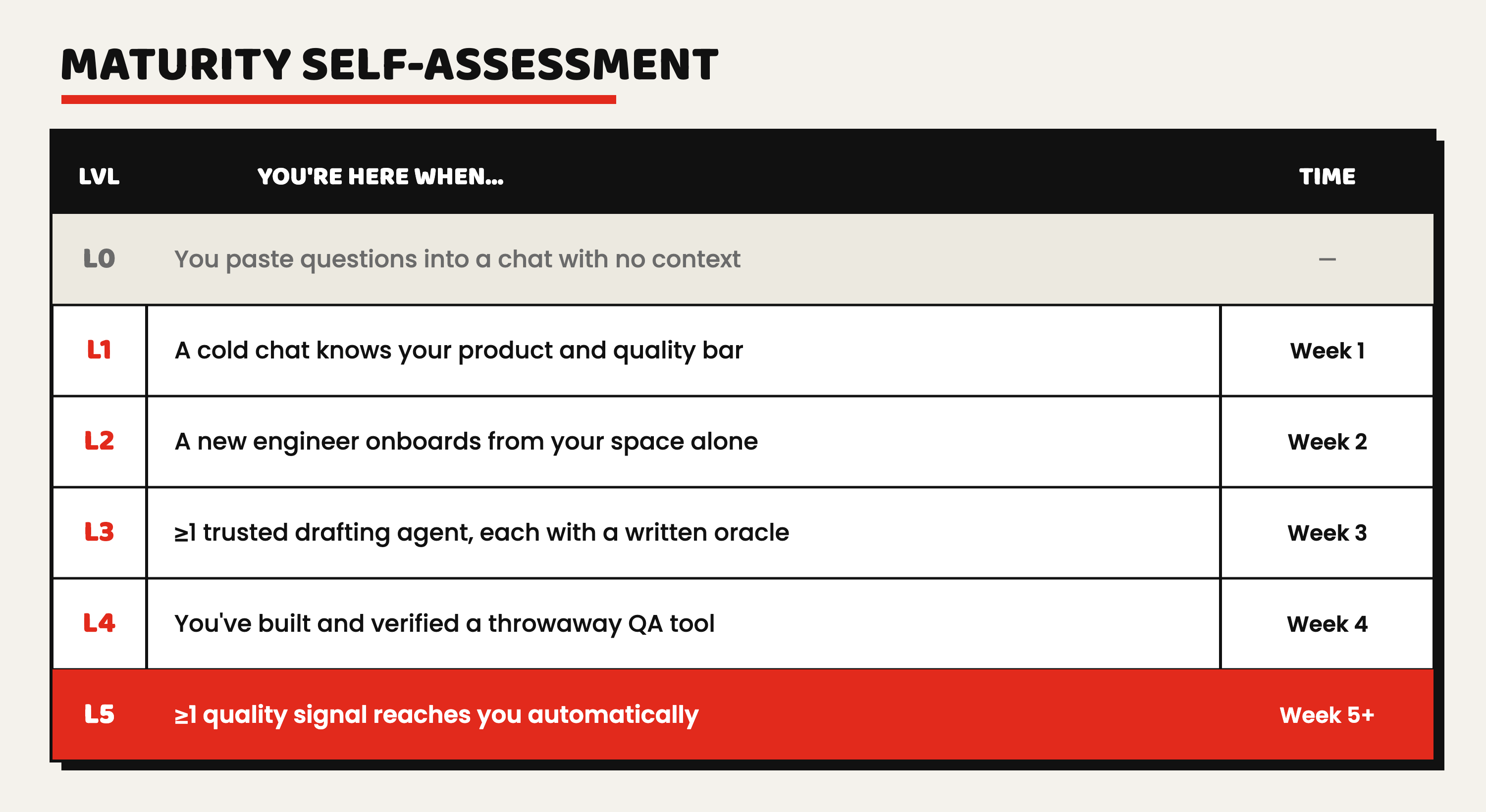
A 30-day route
- Week 1 — L1: build the context pack for one product. Let the agent interview you. Fix the holes it surfaces.
- Week 2 — L2: stand up one project space. Test it with the “onboard a new engineer” question.
- Week 3 — L3: put two routine tasks (bug-report drafting + test-case generation) on agents. Write the oracle for each. Measure the time delta.
- Week 4 — L4: build one test-data generator or log parser. Verify it on a known input.
- Week 5 — L5: set up one automated quality digest. Keep a human gate on anything that acts.
- Throughout: run the Verification Track. Every level, every time.
When people ask me “is this going to replace me?”, I answer with a question of my own — and I’ll put it to you.
How many hours did your team burn last month because the AI confidently said “try again”?
Be honest. If the number is meaningful, the problem isn’t the tool. The problem is that nobody who knows how to say “wrong” was standing between generation and action. That’s you. The agent handed you a generation engine. It didn’t take your oracle away — it made it the most valuable asset on the team.
Starting tomorrow morning, you don’t write every test by hand. You decide which of them actually verify anything. That’s the move from QA engineer to agent operator.
Igor Goldshmidt is a Quality Engineering Architect and consultant who writes about practical AI adoption in testing and developer workflows. This ladder grew out of a methodology I’m road-testing with real teams. Take it, run one level a week, and tell me which one you got stuck on.